Spring?

It is always good to have something to look forward to, but I think we are all tired of looking forward to Spring this year.  I’m even looking forward to shaving off the winter whiskers if only Winter would actually go away.  Despite the extended forecast calling for more frigid, time is marching on.  Spring may not be here yet, but we don’t have any more time to wait on it.  If we don’t get started now we won’t have enough time to get up to speed for Summer.

Cycling season is definitely taking a hit this year.  The first time trial is only 3 weeks away and I’m betting I’m not the only one who hasn’t been out riding yet.  You can only train so much in the basement because hills and wind can’t be properly simulated.  It will be interesting to see how many folks even show up and just how out of shape we all are.

One thing I have been able to get outside to start practicing is carrying a heavy pack.  I have the Kelty external frame loaded up with 50 pounds of training weight and have been doing laps around the block a few times now.  Last year I relied too heavily on cycling to get into shape.  The first trip on trail I really noticed that there are some muscles in the legs that may not be used for cycling but really are needed to carry a pack.  This year, especially with the LT plan for the Fall, I’m cross training from the start.

Lots of other preparations under way as well.  The Baxter reservations have been made for a trip with the TX boys in July.  I have been doing this same loop for the last few years, but with different people each time.  It never gets old climbing Katahdin and then heading off into the back country away from the flocks of peak baggers and AT finishers.

I also ordered my LT guides and map from the Green Mountain Club this week.  Not sure I really needed the End To Enders Guide which details the towns and services available along the trail since my plan is to stay on trail the whole time, but they were still running their Spring special of the trail guide, the E2E guide and the map for $30.  I figured if nothing else it will give my wife a chance to read about all the places we might visit when we do this trail together in a few years.

Other plans are still coming together for the season.  Pretty sure there will be at least one trip on the Grafton Loop again this year and I’d really like to start exploring the Pemigewasset Wilderness in the White Mountains of New Hampshire.  That area is well known for its high loops but there are some creeks on the eastern side that I’m betting will be less traveled and may even have some fish in them.

Still a little time left for planning and dreaming it would seem since they say we may have another big snow next week after the little one this weekend.  That doesn’t mean we can afford to be sitting around too much though.  Better to start moving more now to get ready to move more later is my plan.

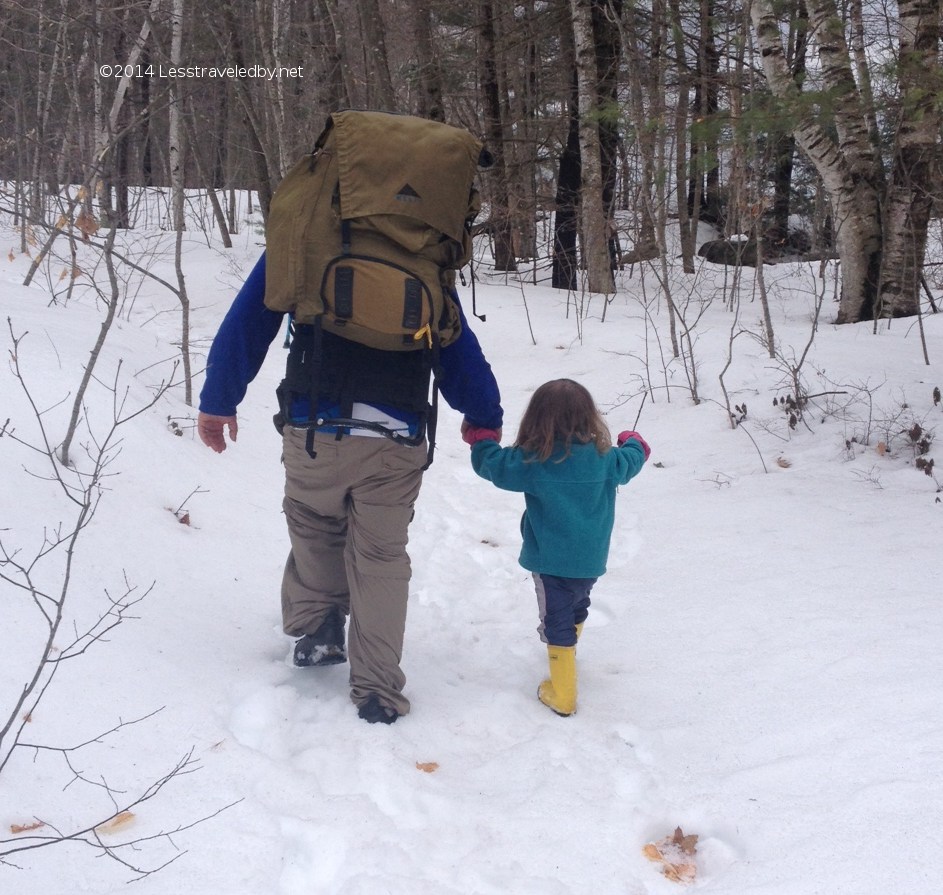
My daughter does her part to help.  She led my wife and I out the door yesterday on what I thought was going to be a walk around the block.  I tossed on the 50 pound pack thinking it would be a nice chance to work on those pack muscles.  Then she proceeded to lead us down the road, into the woods and all the way down to the river through soft mushy snow.  I was definitely feeling those pack muscles, but that girl is smart.  She knows Daddy is going to need strong legs this Summer for family trips.  Best to get me whipped into shape so when she is ready I’ll be able to carry her loads on the path less traveled by
sp14

Updated Gear Review Page

I’ve been posting a bit less on the site here because I’ve been spending a lot of time writing up reviews over at Trailspace  Despite another week of Winter here I know it will be time to get outside soon so I’m trying to get last year’s gear written up so I can go out to play when Spring finally arrives!

The Gear Review page here has been updated with links to seven new reviews including Keen Erickson PCT boots,  Smartwool Trekking socks and some nifty little Vivitar binoculars.  Check out the Gear Review page for a list of my reviews with links to the full reviews on Trailspace.   These are all items I’ve bought and used so they are reviewed base on real life experience.  Hopefully you’ll find them useful.

IMG_2358a

Two Paths Submerged In A Yellow Wood

Some folks never leave the safety of their couches.  They will never know the joy of wondering what lies over that next hill or the joy of wandering over that next hill to find out.  Some of us do leave our couches though and even with years of experience and the best gear it seems wise to recognize that we are taking on risks when we head out there.

If you’re smart you’ve already analyzed the risks and tried to mitigate them.  You plan ahead, know your intended route, have the right gear and know how to use it.  All these things will help ensure things go right and that you’re prepared in case they don’t.  Making sure your body and mind are ready for where you’re headed are just as important as having the right gear.   Even casual trails can be dangerous if you aren’t focused and half way across a narrow stone ledge is no place to find your legs getting tired.

This post is really for the folks who already understand all of that.  The ones who have confidence in themselves built on a foundation of successful adventures and have that drive to go on in the face of adversity.  I want to remind those folks of indomitable spirit that sometimes it is OK to give up and turn back.  The mark of success is not reaching the peak, but rather just returning safely.  That above all else should be the goal.

Now I am not suggesting taking no risks.  I’d much rather die falling off a mountain than falling off my couch, but either way I’m in favor of putting it off as long as possible.  Actually I take on additional risk because I enjoy adventuring solo quite often.  I do that fully aware that I have no one else to rely on but myself and am greatly motivated to focus on safety.  Rather than count on getting myself out of trouble I focus on not getting into trouble.

That requires that thing I’ve discussed before; Situational Awareness.  Being mindful of your environment is where it starts in this case.  You can only avoid the potential injury you see coming.  That means still seeing trees and rocks even after days or weeks of looking at nothing but trees and rocks.  It means remembering where that kettle is coming to a boil as you dance into your wet trail clothes in the morning so you don’t knock it over.  It is a constant and fluid analysis of everything going on around you.

With that in mind I want to talk about recognizing that turning back is an option.  All too often people focus on pushing themselves to go on without fully thinking about the consequences.  That sounds great for a character in a novel or film, but in real life consequences can go beyond painful to deadly all too easily.  I love to push myself to my limits in that wonderful test of will that a good adventure can bring, but only so far as I can be reasonably sure of coming back to tell the story.

So what is reasonable?  When should you turn back?  That is something only you can answer at any given moment on your adventure and the only way you can be prepared to make the right choice is by being aware of your situation.  The choice to turn around should rarely, if ever, come up suddenly.  It is generally something that becomes increasingly obvious as the right choice to make.

I had two trips last year that resulted in turning around.  One was a simple case of logistics as weather got me off to a late, slow start.  At the end of day one of what was supposed to be a four day loop I knew I had to abort because I had no hope of finishing in time.  Tough it out and go for it?  That sounds good but given the weather and terrain trying to go faster would have pushed the risk into unacceptable levels.  My family lets me go on these trips only with the promise that I will come back and I do my part to make sure that happens.

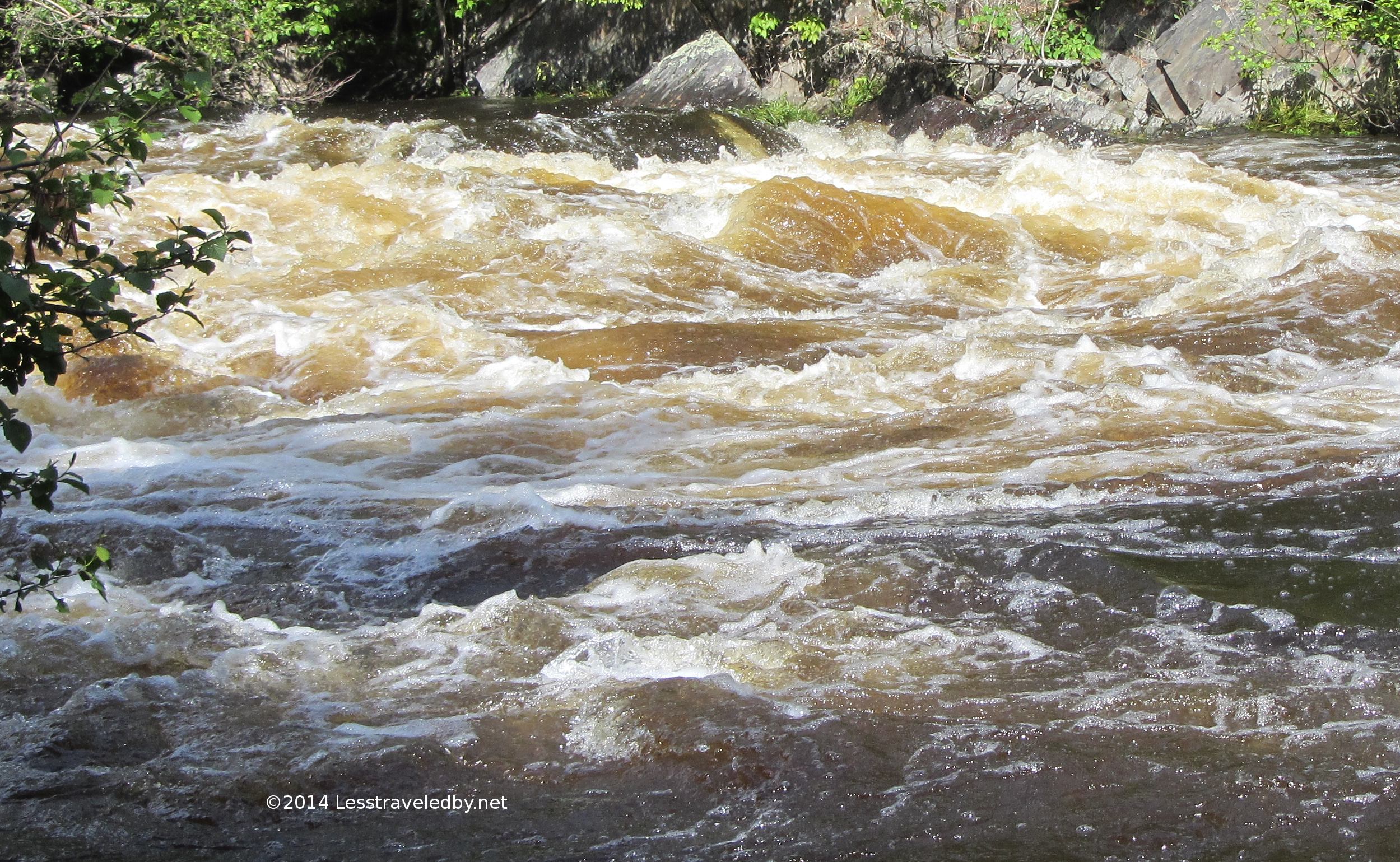
The other trip that involved turning around was also weather related, but on a much grander scale.  Attempting an early season Freezeout/Wadleigh loop in Baxter State Park we were set upon by a deluge.  This rain started as a good soaker and steadily increased to a downpour which didn’t let up for about 36 hours.  The brook our trail followed was a roaring brown and foamy beast.  The up and down hill sections of the trail were like creeks, ankle deep in flowing water and mud.  The bottom sections were either lakes or channels feeding the brook depending on drainage.

We hiked all day in these conditions and as the afternoon waned were all looking forward to reaching our camp for the evening.  Then we ran into a wide area of flowing water coming down from the hills and into the raging brook.  Not daring to attempt the crossing so close to the brook we began bushwhacking our way up this stream looking for a place to cross.  It had climbed over its banks spreading across an area a hundred yards wide or so that was only knee deep, but somewhere out there was the original channel.

Finally after a quarter mile or so of bushwhacking we found another trail coming up out of the creek.  This was our intended trail out of the area in the morning to our next night’s camp.  Already looking at the situation and determining that going forward was looking like a really bad idea we decided to see if we could skip ahead to the following night’s camp.  We didn’t get far before finding that this trail was also blocked headed in that direction by another branch of this same creek.  We stood there calf deep in flowing water pondering our next move.  Water roaring all around us made us shout to talk it out, but all agreed that pushing on in either direction was the fool’s option at this point.  We headed back the way we’d come and camped at the shelter we’d stopped at for lunch earlier.

In the morning we all agreed that despite the longer distance going back the way we’d come made more sense than trying to forward.  The rest of the route would have taken us into what is normally a bog and after the rains was now probably a lake.  So did we leave feeling defeated and somehow lesser for the experience because we didn’t finish our loop?  Absolutely not!

This trip was one of the most fantastic experiences I have ever had.  We were already taking on a loop that very few people make every year and then in the face of an outrageous storm we went to the limits of all but the most foolish of men and returned to tell the tale.  Before we left that spot I shouted something to my partners there as we stood in a foot of moving water between two deep flowing channels.  I said, “Remember this moment well, because no matter how many times you tell this story, and you will tell this story, no one but us three standing here will ever know what this was really like.”

Would we have died if we had gone on?  Maybe, maybe not.  That question never really bothers me because what matters is we were smart enough to not find out.  What more could possibly have been gained than we did by going as far as we did?  Two paths submerged in a yellow wood, we turned around rather than go forward to drown and that has made all the difference on the path less traveled by

IMG_1265a

Leave No Trace Principles: Leave What You Find

Take only pictures, leave only footprints is one of the earliest forms of Leave No Trace ideology I recall running into.  The simplicity of it made instant sense to me then, though now I try not to leave footprints either.  The next of the LNT principles I want to ramble on about is Leave What You Find.  Again, the simplicity makes this whole post sort of a waste of time if you’ve already grasped the concept.  If you log off and go for a hike instead I won’t mind.

OK, now the rest of us who are waiting for the snow to melt or the mud to dry can continue.  So far the principles I’ve talked about were mostly about not making a mess out there or tearing up trails.  This one is about trying to create as little disruption to a balanced environment as possible and about preserving the irreplaceable.

As much as possible we should leave things as we find them so choosing a camp site is a good place to start. Selecting an appropriate site rather than trying to create one works best.  As usual go for high density use options first.  If sanctioned camp sites exist use them if possible as you won’t be adding much impact to the area.

As I discussed previously if you are setting up camp in an area without an existing site the goal is to not leave something that looks like a site when you move on.  Moving logs or big rocks and making trenches are all things to avoid as they cause major disruptions to surface balance.  Avoid over grooming your tent site.  Pine cones have to go of course, but put them in a pile and scatter them back over the site when you leave.  The same with small rocks and sticks.  Sweeping an area clean of debris is not a good idea, but if you must then make an attempt to sweep material back over the area as part of breaking camp.

Another thing to avoid is the human instinct to build.  Making tables, chairs, shelters or other things from rocks, trees and bushes might look like bushcraft on TV, but it is poor stewardship of the land.  Spending a moment in Nature as pure as we can find it should be a time to marvel at what is there rather than changing it.

Plants may bounce back from being damaged, but far better to avoid the damage in the first place. Chopping or sawing standing trees, hacking away at brush, hammering nails into trees or carving into their bark are all against the LNT way of course.  Beyond that those who hang hammocks, bear bags or other things from trees should be sure to use proper equipment and know how to use it in order to minimize impacts.  If staying in one area for more than one night you may want to consider using different trees to spread the impact around.

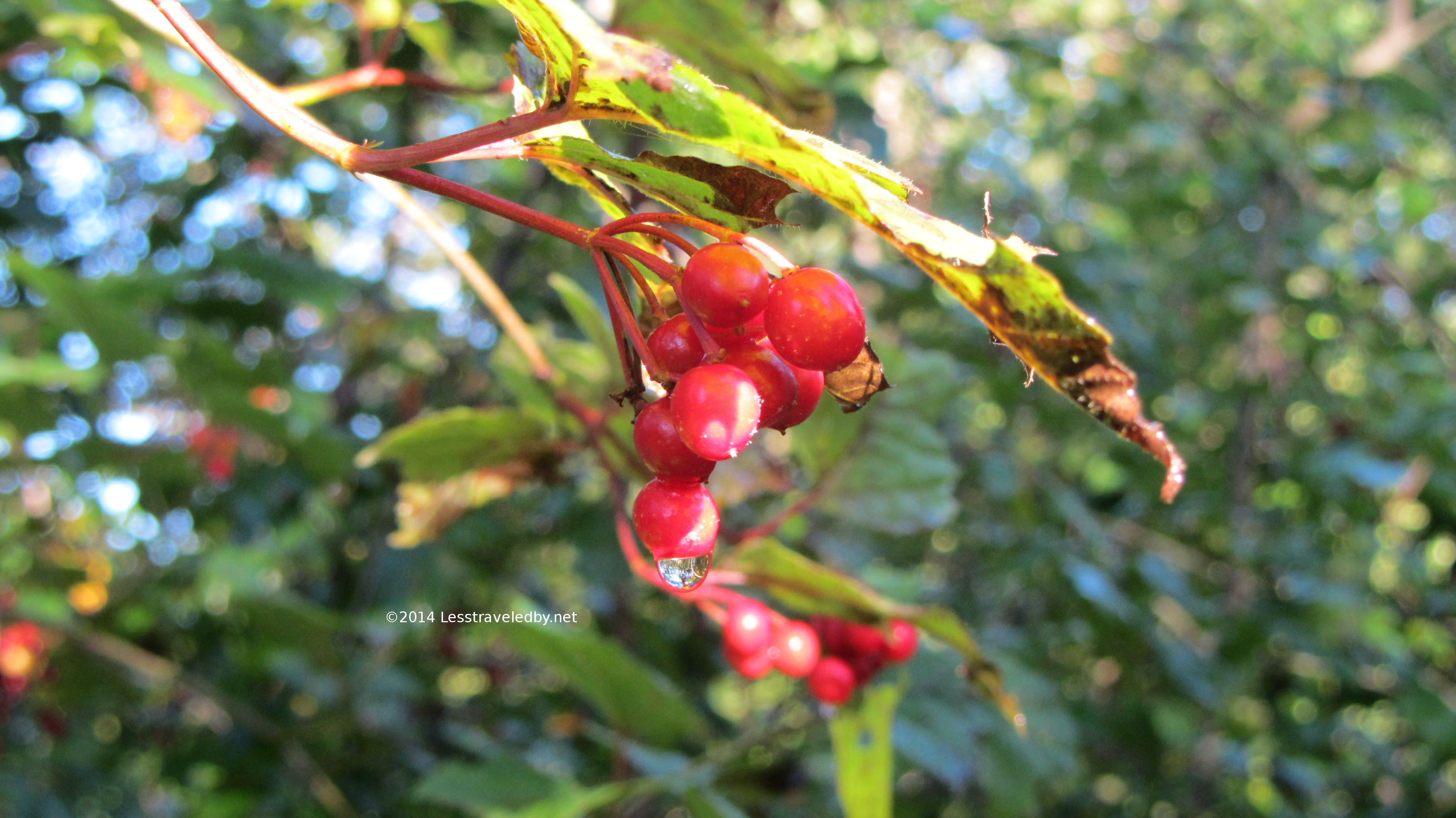
Some folks like to harvest wild plants, berries, mushrooms and roots while on trail.  Foraging has a long history especially among nomadic people and those with the knowledge to do it safely are welcome to harvest small portions.  Avoid stripping an entire area or damaging soil and vegetation during the process.  Gathering small amounts throughout the day along the trail is much better than doing a lot of gathering all in one spot.  Even if the berries are perfectly ripe please don’t strip entire bushes.  Leave some for the local bugs and bears  or the next person coming down the trail to enjoy and look for another bush down the trail.  Flowers on the other hand should be seen and not picked.  As with hunting game only take what you will eat.

The other important category of things to leave as you found them is artifacts.  This term covers both natural and human objects you encounter.  Antlers and bones are examples of natural items while human objects may range from ancient tools and pottery to more modern objects left by trappers, miners, loggers and farmers who may have worked the land today’s trails pass through.  I have come across some surprising things along the trail and I’m always glad that those who passed before me left them for me to find.  If you take, break or even just disturb these sort of objects you are denying the folks who come after you the experience of discovery you were allowed to have.

That really is what Leave No Trace is all about of course.  Enjoying the experience without changing it so that others can enjoy it too.  So take pictures, leave footprints and perhaps a few leaves trodden black, but let’s all work together to make it dang hard to figure out which really is the path less traveled by

IMG_1735a

Gear Reviews

I have added a new page to the site today in order to keep an updated set of links here to my gear reviews on another site.  It didn’t seem to make sense to duplicate the reviews here and it didn’t make sense to stop writing my reviews there just because I created this site.  They reach a lot more people and do a lot more good there.  So I will keep reviewing there and try to remember to update this page with new links as reviews go up.  You can find this new page via the menu at the top of the site.

Before I buy anything I like to do a lot of research to see how things work for others in the real world.  Most things you have to try for yourself to find if you really like them, but if pretty much everyone is having a bad experience with a product I tend to skip that step heh.  Reading reviews also lets me learn about gear I will probably never have a need for as well as a lot of things I’ll never be able to afford.

Knowing what you are looking for and details of the products you see on the shelf can help you deal with salesmen who attempt to sell you what they want to sell rather than what you need.  It is rare that I run into sales staff who know their wares as well as I do before I go into their store.  The more you know before you step into the store the more likely you are to avoid being sold the wrong gear for your purposes.

So next time you are in the market for gear do yourself the favor of a little research before heading to a store to talk to an “expert”.  Thanks to the Internet there is a lot of information available to us out there if we’re willing to look around.  A little knowledge goes a long way whether down the aisles of your favorite outdoor store or on the path less traveled by

gear

The Sounds and Smells of Spring

Never mind the sub zero forecast the next few nights, Spring is here!  Well in my house at least the season has begun because the gentle hum of the dehydrator can be heard and magical smells have begun to come pouring out of it.   The first steps in putting together this year’s trail meals are under way despite the weather refusing to acknowledge March’s arrival in the least.

When I first started to get back out on the trails I was excited about the advances that had been made in dried foods available for backpacking.  The flavors and textures seemed so great compared to the horrible memories I had.  Then I started to notice the nutrition information and my enthusiasm began to wane.  As I began to spend more and more nights on trail the cost started to become an issue as well.  The last straw for me came when I realized that while some of the meals were genuinely enjoyable, many others were just something to force myself to eat at the end of the day so I didn’t have to carry extra weight in my garbage bag.

First I did some research online to see what was working for other people.  I found that there were a lot of people who had felt the same and decided to make their own meals so they could control what went in and how the meals came out.  Some continued to cook in bags like the commercial products.  Others found that after preparing all of the ingredients they enjoyed cooking one pot meals with them.  No matter what style of food you like or how you like to cook it up being able to create meals to your own tastes and knowing exactly what went into them brings a little extra comfort at dinner time.

My preference is to create individual bag meals that I cook just like the commercial products simply adding hot water to the bag.  This allows for good portion control along with no clean up and limited garbage creation.  Before each trip I put the bagged meals together from ingredients I have kept in the freezer for long term storage after drying.

Some folks like to dry complete dinners but different types of food have different drying requirements and over dried items can be very hard to rehydrate while underdried items risk spoilage.  That is one of the reasons I dry and store ingredients in batches so that each item is dried properly.  Another is that I can create a variety of meals by mixing and matching sauces with meats, starches and veggies.  As an example I make a fiery red pepper sauce that mixed with shrimp and angel hair gives a nod to fra diavolo but when mixed with ground beef, ditalini  and cheese becomes sort of a chili mac.

Right now I have some green chili sauce and some refried beans drying.  The house smells wonderfully spicy which makes it feel a little warmer despite the chill outside.  Learning comes via both successes and failures and there have definitely been some failures.  I try to test every meal at home so there are no surprises on trail.  Generally I make things in batches that can be split into four portions.  Then I will test one portion from each batch by making and eating a test meal from it.  My goal is to never be surprised by an inedible meal on trail.  I have had a couple that were a bit crunchy and had to be forced down but I’ve never gone to bed hungry which is the important thing.

This year I have added a couple of commercial items to my larder.  I ordered a 2 pound can of Nido dehydrated milk and a package of cheese powder because drying dairy is not something for amateurs to do.  The milk will add fat and protein to a granola cereal breakfast and combined with the cheese power will make cheese sauces for dinners.  I’m guessing there will be a few failures learning to use the cheese powder but at least they will be cheesy failures.

This year is going to pose a couple of new challenges in terms of putting meals together.   We plan on getting at least a short way down a few trails with our daughter this year.  That cheese sauce idea was inspired by her love of cheese and before I’m done I hope to add a few more items to the menu with her in mind.  Late in the year I’m looking at doing a no resupply Long Trail trek that will also add some new wrinkles to meal planning since weight and calorie density will need to be considered for every meal.

Even after these next few cold nights the forecast doesn’t call for much of a warm up.  Spring seems to be taking its time out there almost as if it has read the calendar and knows there is no hurry.  As much as I’d like to hurry it along I know Mud Season will only follow so there is no sense rushing it.  For now I have time to start filling the house with wonderful smells, filling my freezer with boxes and bags of things that will later fill my tummy and of course filling my head with thoughts of delicious dinners with feet propped up at the end of the day on the path less traveled by

IMG_2426a

What Was That‽

There is that moment, maybe just before you fall asleep, maybe just after.   All is peaceful with your body and mind at rest.  Then…SNAP!  Somewhere in the dark something has broken a branch, or was that a whole tree‽  In an instant you go from peaceful rest to full adrenaline rush.  Eyes trying to see in the dark, ears straining to hear something other than your pounding heart.  Slowly you get your self under control and then just as you are about to fall asleep again…SNAP!

We’ve all been there, but this came to mind today after reading Racoon Travel’s post today asking how folks deal with being alone in the woods at night.  It got me to thinking about how I’ve changed over the years in my feelings about the noises in the night or just being alone in the woods for that matter.   As social and communal animals just the act of going into the wilds alone can be unsettling.  With no conversation to distract us from it we become acutely aware of how alone we are and how small we are in the face of nature.

Growing up on a farm I was used to being outdoors alone from an early age.  Whether working in a distant field or tramping through the woods there was never any concern.  I think the first time I recall feeling any sense of fear in regards to nature was on a trip to the Tetons in the early 80s.   Day hiking alone on a trail through very thick forest I came upon some monster sized bear tracks.  These were not the black bear sized paws I was familiar with.  There was no doubt that a pretty good sized grizzly had made these prints.  My resolve lasted only a few minutes more as I followed them in the same direction I was headed then I turned back and at a pretty good pace as I recall heh.

In the years since I have done a lot of solo camping, first on my motorcycle and now on foot.  While going alone into the wilderness brings challenges, facing those challenges can bring great rewards I’ve found.  Looking back now I can see how things have changed and how some of them have stayed the same.  I may not turn around as easily, but fear is an instinctive emotion that travels quicker than logical thought so often arrives first heh.

Back in the 90s I used to visit Mt Palomar near San Diego on a frequent basis.  Camping there I had one of the most disturbing and hilarious brushes with nature.  I was in my tent laying down for a late afternoon nap.  Staying up late to watch the stars was a favorite activity on Palomar so naps were not uncommon the next day.  As I lay there I began to hear something approaching through the underbrush.  Slow stealthy steps to be sure, but the sound was unmistakable.  As the sounds grew louder and louder my heart began to race.   Peeking out from my tent to see if I could spot this great beast I noticed movement.  There, just outside my tent, was a half inch long beetle scuttling through the dry grass and leaves.  His tiny legs just inches from my head were making the sound that had me so scared.

Spending more and more time alone out there I have fewer and fewer of these moments.  Even the noises in the night don’t have the same effect.  Sure that initial adrenaline shot will get my heart pounding for a minute, but now I’m just as apt to roll over and go back to sleep as I am to stay up wondering what that was I heard.  Maybe I’m just getting old, but I seem to be more at peace with nature than in fear of it.  I have plenty of respect of course, but see myself as working with it rather than fighting it.

Last Fall on my aborted Grafton Loop trip I hiked in a cold rain all day then set up camp below Sunday River Whitecap.  Filtering water and eating a rushed dinner got me out of my wet clothes and into my tent as the temps began to dip into the 30s.  Dark came early and the night was going to be long so I started napping pretty fast.  Then in the darkness there came a snort.  That is a noise generally reserved for your larger animals.  Chipmunks don’t snort and neither do sparrows.  No, a snort usually comes from something pretty good sized and this one sounded pretty close.

The sound came again and as logic had caught up with instinct I burst out laughing.  All I could think of was that one of nature’s majestic beasts, be it a bear, deer or moose, had just gotten a snoot full of my wet socks and was likely snorting in horror.   Still chuckling to myself I heard a few more snorts but was soon asleep again.  That trip had to be cut short due to weather and logistics but definitely not due to snorts in the dark.

Maybe I’m just getting old but those moments of sheer terror don’t come as often.  I’m ok with less terror, not so much with the getting old, but I do enjoy going farther out there alone than ever before.  The challenges to be faced and the rigors to be endured are well worth the effort to be able to soak in the sights, smells and even the snorts on the path less traveled by
IMG_1417a

Be Careful What You Ask For

You just might get it.  Those moments when things come together are interesting.   When we cross over a line and something we’ve dreamed of doing becomes something we actually are doing.  In crossing that line we’re moving towards getting what we wanted, but now we are faced with the task of actually doing.

The other day I accidentally got my wife’s blessing to do the Long Trail in Vermont this Fall.  I say accidentally because I wasn’t even really thinking about going until we are able to do it together years from now.  Then it came up in conversation and she told me to go before I even really asked.  If I didn’t know it was love I’d think she was trying to get me out of the house, but offering to solo parent for a month while I’m out living my dreams is definitely love.

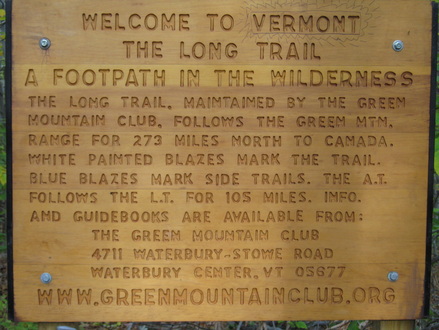
The first time I heard of the Long Trail I began to dream of walking it some day.  I didn’t think I ever actually would as I’m not really a thru hiker, but it sounded like my sort of adventure so a nice dream.  Officially 273 miles stretching from the Massachusetts border on the south to the Canadian border on the north the trail goes the length of Vermont.  Following the Green Mountains it is a long series of peaks and valleys getting peakier as you head north.

The AT joins the LT for the first hundred miles in southern Vermont.  This section sees much more traffic and once the AT heads off to NH and ME on its way to Katahdin the Long Trail continues on more lightly traveled.  As the trail heads towards Canada it becomes progressively more challenging.  Some folks like to do it in the other direction to get the hardest part out of the way first while others work their way up to those peaks training their legs as they go.

Along with crossing all of those mountains and valleys the trail passes near many small Vermont towns as well as some wonderful B&Bs and inns.  Most people will go into town every few days for resupply and many folks plan a day of resting and feasting at one or more of the inns.  My plan is somewhat different as I’d like to save those treats for a future trip on this trail with Mrs Stranger.   Traveling together seems to be the time to enjoy those niceties while this solo trip is better suited to something more challenging.

My plan is to do the entire trail end to end without resupply and without leaving the trail.  Any zero/low mile days, if I decide to take them, will be on a mountain rather than at an inn.  In fact I’m planning on avoiding using the shelters as much as possible in favor of setting up camp alone off the trail.   Despite the fact that this trail passes close to civilization often and the shelters can be social centers my intent is to make this a true escape from all of that as much is possible.

Now that this plan is in motion there are many things to consider.  How to carry enough food and fuel for 20 days or more?  How many cookies to bring?  Will I be tempted by inviting inns close enough to the trail that I can hear the clink of pint glasses?  Will I give in to that temptation?  Finding out the answers to all of these questions as well as many more is what this trip is all about.

To me getting out there has always been about questions and answers I guess.  What am I capable of in terms of body and spirit?  What is the view like from the top of that mountain?  Will it ever stop raining?  We have to be careful about the questions we ask ourselves too I guess.  I am anticipating more than a few nights alone in my tent filled with answers I can only hope I’m prepared for.  I guess that pretty much sums up my life though, hoping I’m prepared for the answers I find on the path less traveled by
LTSign

Leave No Trace Principles: Proper Waste Disposal

It’s a dirty job, but somebody has to do it.  Proper waste disposal is the third of the LNT Principles and it involves stuff we’d all rather not think about or bother with, but if we don’t all do our part it can really make a mess of things out there.  Preparation again is key both in terms of what you bring with you and having a plan in advance.

There are really only three categories of waste to be concerned with; human, liquid  and everything else.  Part of preparation is knowing the area you’ll be visiting.  Of course you’ll want to know if they have any specific regulations regarding waste disposal but knowing the lay of the land will help you as well.

Oddly enough the “everything else” group is the easiest to figure out how to deal with.  Pack in/Pack out and you’re done.  If you aren’t willing to carry it with you when you leave then don’t take it out there.  Again preparation comes into play as you can change your behaviors to minimize the amount of waste produced.  Meals should be sized so they can be completely consumed.  Limiting odors is highly advised to avoid attracting wildlife.

Depending on your pack you’ll have to figure out the best way to carry your trash.  The container you use may vary depending on how you’ll carry it, but I find a large, one gallon zip bag works well for even extended trips.  I carry it in an outside mesh pocket just in case but there really is nothing to leak out even if it was to come open.  My daily trash output is wrappers from food bars I eat during the day and a quart freezer bag from my dinner.   I can easily carry a week’s worth of trash so long as I can choke down my entire dinner every night.  Some times I have to force myself to eat it all but not having to carry it is a good motivator.

Liquid waste is also pretty simple to figure out a plan for.  This is just water that you are using to wash gear or yourself and water used to prepare food but not consumed.  The goal here is to avoid contaminating the watershed.  Most every place will advise you dispose of waste water at least 200 feet from lakes, rivers and even dry washes.  That’s about 70 steps but better farther than not far enough.  Try to avoid using soaps as much as possible and screen water used to clean pots and dishes for food pieces which you can add to your carry out bag or bury in a cat hole.

Planning can again help to reduce the amount of waste produced.  I only boil water in my pot so it never needs to be cleaned and I eat right out of my dinner bag so I don’t have a dish to wash either.  I do my body cleaning with sanitary moistened wipes so there is no soap or waste water issue though I do of course have to carry the used wipes out.

That just leaves the human waste issue to deal with.  Something I talked about in relation to surface preservation applies here too; if there are existing high impact sites use them, if not disperse.  In this case that means if you have access to existing latrines along a trail take advantage of them when you can.  Concentrating human impact can be a bit distasteful in this case, but it is more easily mitigated this way assuming the managing authority has planned and maintained the site well.  If your trip takes you on a trail without such luxuries or you are off trail then try to spread your impact out by not using the same location twice.  Groups should coordinate to avoid creating clustered locations.

Liquid human waste requires no special steps other than the 70 or so needed to get the 200 feet away from water, camp or trail you should be.  Unless there are any special regulations or recommendations in place a cat hole is the accepted standard for solid human waste disposal.  A shallower hole of only about 4 inches is advised in hot dry climates with a few inches deeper advised for areas with wetter soils.  TP should be carried out rather than left behind and the hole filled back in when you are done.  Some alpine areas advise leaving human waste exposed on the surface for faster break down and to minimize surface damage.   One of the many reasons to research an area before heading out.

None of this is very complicated, but thinking about it ahead of time really makes a difference.  Then when you are out there adventuring it helps to keep looking for things you could eliminate or do differently to make it easier on yourself to do the right things.   I know my garbage bags used to be a lot heavier at the end of a trip, but now they are much more manageable.

So give it some thought before your next trip.  Then give it some thought while you are out there.  How can you make it easier on yourself to do the right things.  What can you do a little differently that might make a big difference on the path less traveled by?

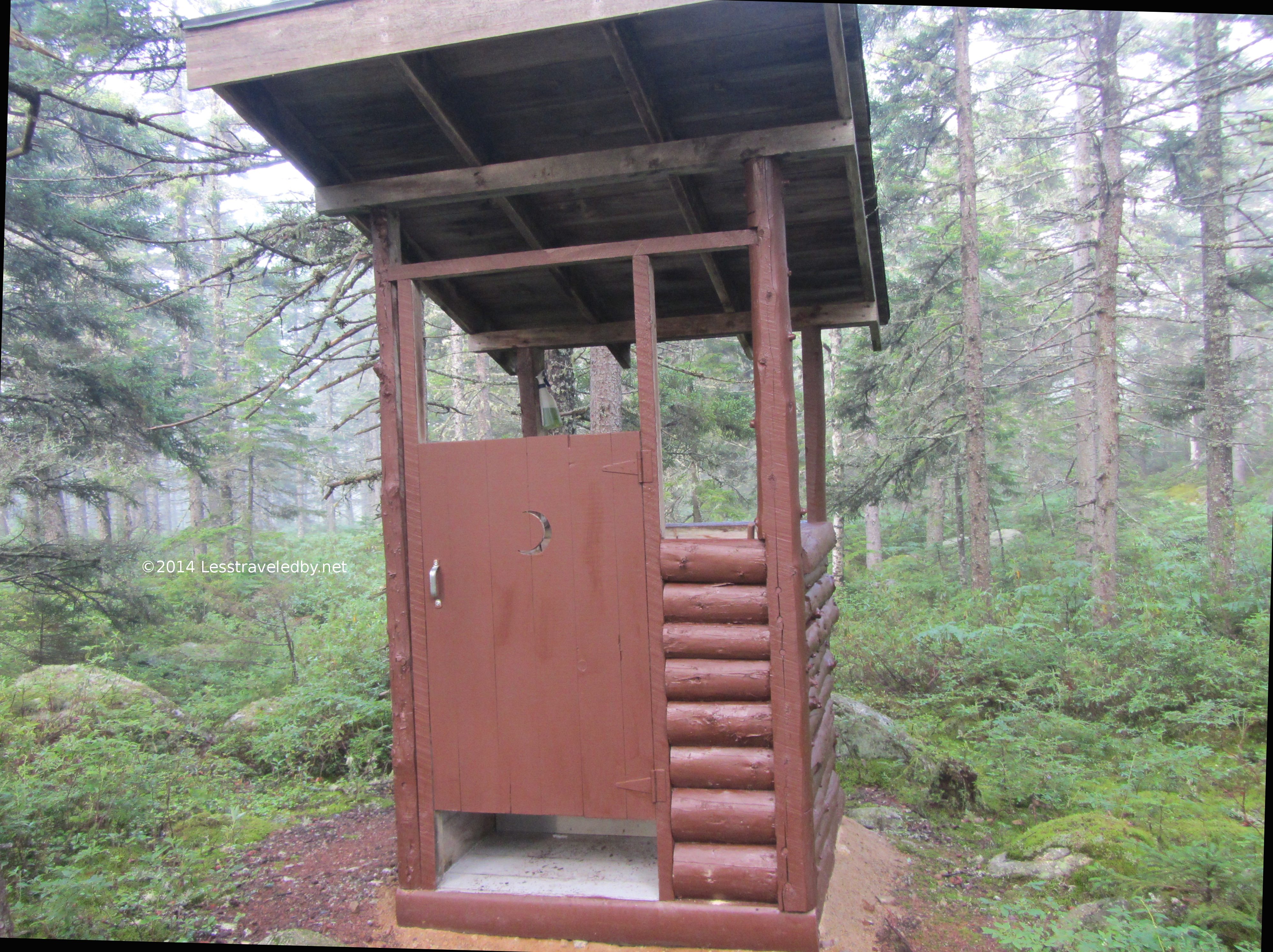
IMG_1393aEn plein air is not just for painting as this beauty shows.  Building it facing the camp site might have taken things too far though.

Camping Weather

What comes to mind when you think of camping weather?  Sunny days?  Starry nights? Blizzards, gale force winds and pounding rains?  Maybe it is just me, but that last group is what I think of.  It probably started out of necessity because  it seems that most every trip coincides with some major meteorological event.  My early camping memories are of the sound of fat raindrops on canvas tents.  The smell of wet canvas still comes easily to mind despite the many years because it filled those tents both small and large long after they had dried.

My tents have gotten a lot less smelly and a lot less leaky over the years not to mention a lot lighter.  My clothing and sleep system have also come a long way from my first Smokey Bear sleeping bag and the days of blue jeans and t-shirts.   As my gear and methods have improved weather has gone from being something to avoid to something to get out into.  If I know 8 inches of rain are going to fall I’m going to stay home rather than risk my life in a flood, but I’m not about to let the average storm keep me off the trail and sometimes I make a point of getting out into the more exciting forms of weather.

Weather has to be respected of course.  You may have noticed one of the few links to the right leads to the .gov weather site.  Their tools allow you to get spot forecasts based on specific GPS coordinates which take elevation into account.  Elevation changes weather a lot at times so going by the local airport forecast may be very misleading if you are headed to a mountain top.

I have many of my favorite spots bookmarked so I can easily get an idea of what to expect if I head out.  Of course just because the forecast says something before you leave doesn’t mean that is what will happen.  If you are heading into the back country it only makes sense to come prepared for a wide range of weather surprises.  It also helps if you can learn to read weather patterns so what happens next is less of a surprise even if the forecast is wrong.

There’s just something both exhilarating and comfortably relaxing about being out there in foul weather and knowing that you are just fine.  The sound of rain or snow on a tent is magical as far as I’m concerned.  While a flapping tent can be annoying the majestic roar of a big piece of air moving past or just near by, even if it jolts you awake, is an exhibition of nature to be savored.  Yes a perfect sunset is perfect and a starry night is one of the best reasons to drag your butt up a mountain, but I think so long as I don’t take a whiner along with me, foul weather is just fine by me.

IMG_2401a

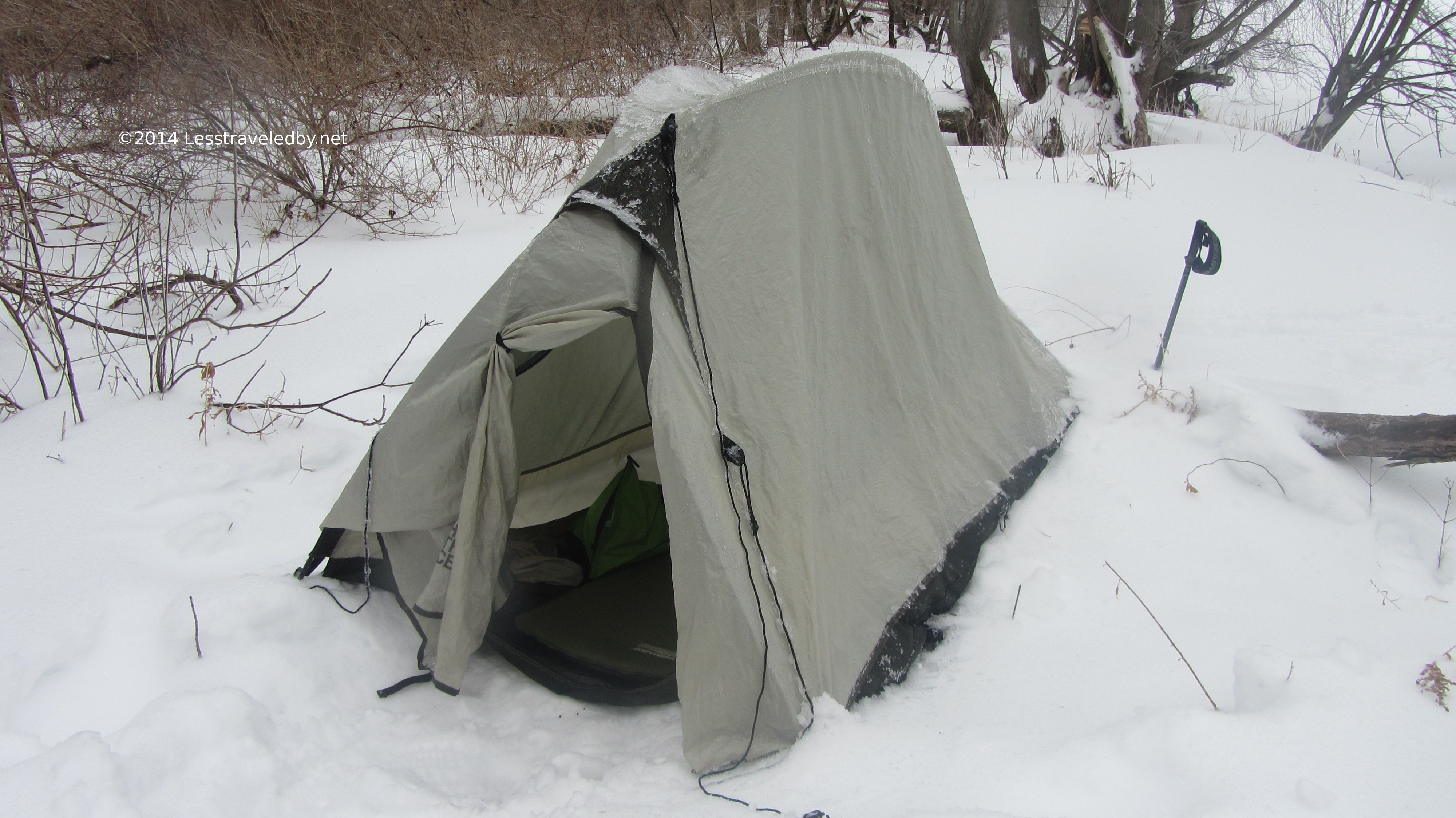
Living what I preach I headed out the other night into a minor blizzard.  Setting up camp in gale force winds after stomping through close to a foot of fresh snow was interesting to be sure.  I got lucky on my wind direction guess and though the lee side was flapping like a loose sail I didn’t have any drifting from under the fly.  Not bad for a three season tent set up in the middle of a storm without using a lantern.

IMG_2397aThe snow turned to sleet about the time I got the tent up and a couple of hours later turned to freezing rain for a while.  My old TNF bomber rides out pretty much any weather but using my hiking poles to set up deadmen and setting up stern to the wind with some snow prepacked on that side seemed like a good idea.  There was some tremendous roaring going on out there but things were pretty calm inside.

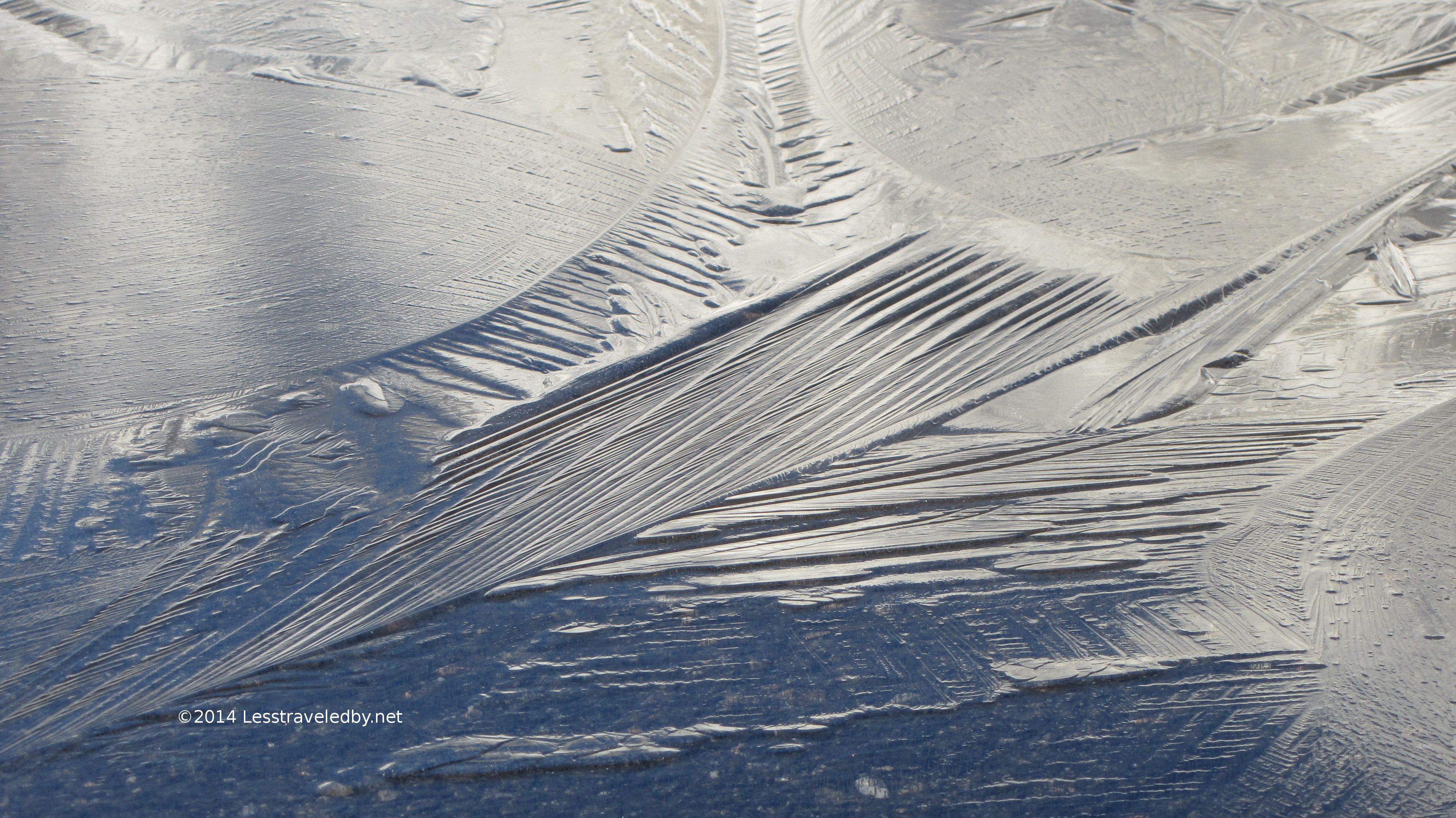
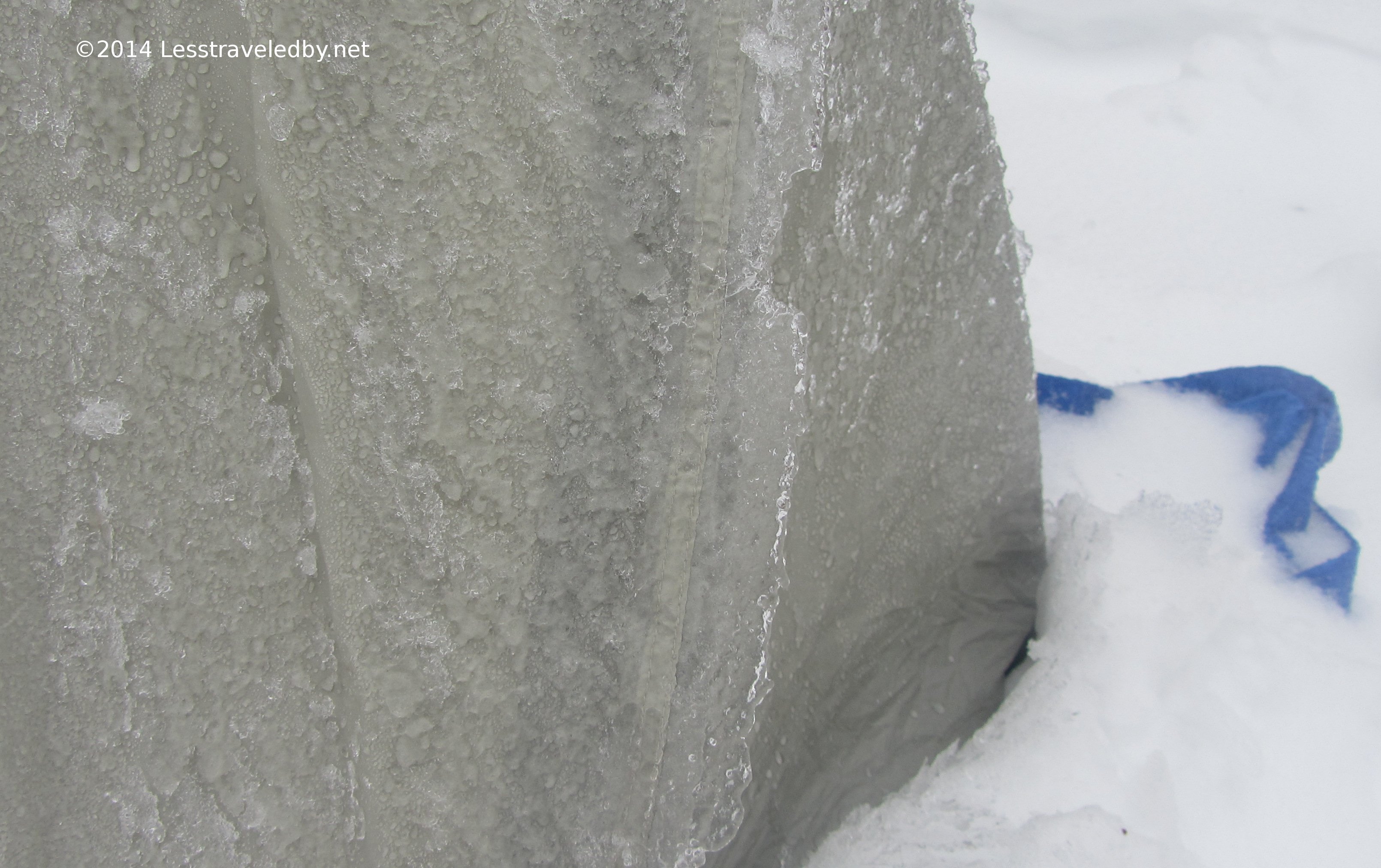
IMG_2399aThere wasn’t a lot of ice build up in the morning but enough to make me glad I was only out for one night.  I set up the stove outside the front door and had my cocoacino before I got out of bed.  My footprints from the night before were hard to follow in spots and completely gone in others.

Now they say another potential big storm is coming tonight.  I think my gear is dried out but I’m not sure if my legs have recovered from postholing through the deep snow.  Oh well, nobody said it would be easy, but there is plenty of  adventure to be found on the path less traveled by